
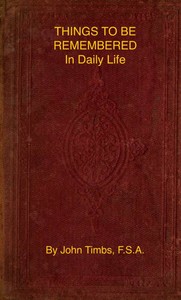
Things to be Remembered in Daily Life by John Timbs
Let's be clear from the start: This is not a novel. If you're looking for a plot with a beginning, middle, and end, you won't find it here. Instead, John Timbs offers something else entirely—a collection. Published in the 1850s, 'Things to be Remembered in Daily Life' is exactly what the title promises: a compendium of anecdotes, observations, historical footnotes, and practical advice that Timbs thought was worth holding onto.
The Story
There isn't one linear story. Think of the book as a series of very short, very chatty essays. One moment Timbs is telling you about the origins of common phrases, the next he's recounting the story of a daring rescue, and then he's musing on the importance of punctuality or the curious history of everyday objects. He gathered these snippets from everywhere—old books, contemporary news, his own experiences. The 'plot' is the journey of his curiosity. He sifts through the noise of daily life in Victorian England and picks out the shiny bits: the humorous, the heroic, the oddly useful, and the simply strange. It's a guided tour through the attic of 19th-century knowledge.
Why You Should Read It
I love this book because it feels like a conversation with a brilliantly read, slightly eccentric uncle. Timbs wasn't trying to write a grand thesis; he just wanted to share cool things he'd learned. His joy in discovery is contagious. Reading it reminds you that history isn't just about kings and battles—it's about how people laughed, what they worried about, and the little tricks they used to get by. In our age of information overload, there's something deeply satisfying about these compact, self-contained nuggets of wisdom and wonder. It teaches you to look closer at your own daily life. What small marvels are we missing because we're moving too fast?
Final Verdict
This book is a perfect companion for curious minds. It's ideal for bedside reading—just a few entries a night. History lovers will enjoy the primary-source feel, trivia buffs will feast on the facts, and anyone who appreciates the art of good conversation will like Timbs's friendly tone. It's not a page-turner in the traditional sense, but it is a consistently surprising and charming dip into the past. If you've ever fallen down a Wikipedia rabbit hole just for the fun of it, you'll feel right at home here.
This masterpiece is free from copyright limitations. It is available for public use and education.
Matthew White
1 year agoRight from the opening paragraph, the objective evaluation of the pros and cons is very refreshing. I appreciate the effort that went into this curation.
Patricia Davis
1 year agoIf you're tired of surface-level information, the bibliography and references suggest a high level of research and authority. This exceeded my expectations in almost every way.
Mark Scott
2 years agoThe formatting on this digital edition is flawless.
Thomas Miller
8 months agoI've gone through the entire material twice now, and the argument presented in the middle section is particularly compelling. I am looking forward to the author's next publication.