
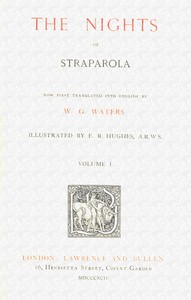
The nights of Straparola, volume 1 [of 2] by Giovanni Francesco Straparola
So, what's this ancient book actually about? The frame story is simple and brilliant. It's 1550 in Venice, and the plague is raging. A noblewoman named Ottaviano Sforza escapes with her entourage to a lush palace on Murano. To keep everyone's spirits up (and minds off the death outside), she proposes a rule: for thirteen nights, everyone will gather after dinner. Five of her ladies-in-waiting will each tell a story, and then the group will sing a song. That's it. That's the whole plot structure. But within that frame, we get a fireworks display of 75 individual tales.
The Story
Don't go in looking for a single narrative thread. This is a story *about* storytelling. Each night, the ladies take turns spinning yarns that are a bizarre and wonderful mix. You'll find proto-versions of famous fairy tales—a cat helps a poor miller's son trick a king, a merchant's youngest daughter requests a simple rose and gets a beastly husband. But you'll also find dirty jokes, clever riddles, fables about talking animals, and sharp satires about corrupt priests and greedy merchants. The tone swings from magical and heartwarming to downright raunchy and cynical. The through-line is the lively atmosphere of the telling itself—you can almost hear the laughter and gasps from the fictional audience.
Why You Should Read It
Reading Straparola feels like being let in on a secret history. This isn't a refined, moralizing collection. It's raw, popular entertainment from the Renaissance. What struck me most was the agency many of the characters have, especially the women and the lower-class heroes. The clever peasant often outwits the arrogant prince. A resourceful wife saves her foolish husband. Magic is a tool for social climbing and justice. It's subversive in a quiet, fascinating way. You're seeing the blueprint for centuries of stories, but with all the rough edges and adult humor still intact. It's less about a moral and more about a good, surprising tale.
Final Verdict
This book is perfect for fairy tale nerds who want to go back to the source, for readers who loved the gritty feel of The Witcher stories or Angela Carter's The Bloody Chamber. It's also great if you just enjoy short, punchy stories with a historical twist. A word of caution: the language and some themes are very much of its time, so it's not a sanitized read. But if you're ready for that, The Nights of Straparola is a captivating, funny, and genuinely important window into how we tell stories. Keep a glass of wine handy and imagine yourself in that Venetian palace—you're in for a treat.
This work has been identified as being free of known copyright restrictions. You can copy, modify, and distribute it freely.
Elizabeth Jones
10 months agoIt took me a while to process the complex ideas here, but the concise summaries at the end of each section are a lifesaver. This adds significant depth to my understanding of the field.
Linda Thompson
9 months agoHaving followed this topic for years, I can say that the argument presented in the middle section is particularly compelling. A rare gem in a sea of mediocre content.
Elizabeth White
3 months agoThe digital formatting makes it very easy to navigate.
Matthew Lee
2 years agoI didn't expect much, but the character development leaves a lasting impact. A true masterpiece.







John Martinez
1 month agoExtremely helpful for my current research project.