
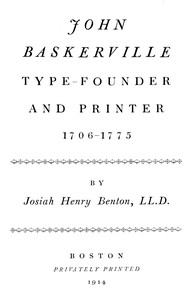
John Baskerville, type-founder and printer, 1706-1775 by Jr. Josiah H. Benton
Let's be honest, a biography of an 18th-century type designer doesn't sound like a page-turner. But trust me, this one is different. Josiah H. Benton wasn't a historian by trade; he was a lawyer with a serious hobby. He fell down the rabbit hole trying to learn about John Baskerville and found… almost nothing. That lack of information became the engine for this whole book.
The Story
Benton lays it out like a case file. He starts with the known facts: Baskerville was a printer in Birmingham, England, who created a stunningly clear and elegant typeface in the 1750s. People either loved it or hated it. Then, after his death, his grave was vandalized, his business faded, and his personal story was wiped clean. Benton takes us step-by-step through his investigation. He tracked down Baskerville's will, dug through parish records for his birth and marriage, and collected every scrap of correspondence he could find, including wonderfully cranky letters Baskerville wrote complaining about critics and paper quality. We see Baskerville not just as a name in a history book, but as a real person—perfectionist, ambitious, and famously difficult. The "plot" is Benton connecting these dots across 150 years to rebuild a life from the ashes of neglect.
Why You Should Read It
You should read it because it's a double biography. It's about Baskerville, the innovative craftsman whose work we still use every day, often without knowing it. But it's also about Benton's quiet passion project. There's something deeply human about his dedication. He isn't writing for fame; he's writing because he thinks the story deserves to be told. You feel his excitement with each new discovery. The book makes you see the everyday world differently—you'll start noticing Baskerville's type on book covers, documents, and street signs, and you'll know the story of the stubborn man who made it.
Final Verdict
This isn't a dry technical manual on printing. It's a story for curious people. It's perfect for history buffs who like niche, human-scale stories, for designers who want to know the origin story of a classic font, and for anyone who appreciates a good historical detective story. It's a short, focused read about how beauty and legibility have a history, and about the patience required to recover it. If you've ever fallen into a Wikipedia hole late at night chasing a random fact, you'll understand Benton's drive completely.
No rights are reserved for this publication. Distribute this work to help spread literacy.
Nancy Smith
2 years agoI found the data interpretation to be highly professional and unbiased.
Donald Martinez
1 year agoThe layout is perfect for tablet and e-reader devices.
Thomas Gonzalez
2 years agoThe citations provided are a goldmine for further academic study.
William Thomas
7 months agoThis was exactly the kind of deep dive I was searching for, the inclusion of diverse viewpoints strengthens the overall narrative. Thanks for making such a high-quality version available.






Charles Jackson
5 months agoThis was exactly the kind of deep dive I was searching for, the breakdown of complex theories into digestible segments is masterfully done. This should be on the reading list of every serious professional.