
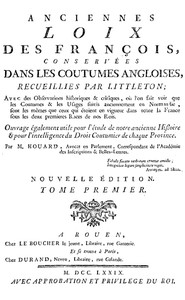
Anciennes loix des François, conservées dans les coutumes angloises,…
David Hoüard's Anciennes loix des François, conservées dans les coutumes angloises (Ancient Laws of the French, Preserved in English Customs) is not a novel with a plot in the traditional sense. Its 'story' is an argument, a scholarly pursuit laid out across two volumes. Published in the late 18th century, the book presents Hoüard's central thesis: that the bedrock of English Common Law isn't purely Anglo-Saxon, but is deeply indebted to the legal traditions of ancient France, specifically those brought to England by the Normans after 1066.
The Story
Think of Hoüard as a legal archaeologist. He digs through layers of history, comparing old French legal codes and customs with established English legal principles and court decisions. Page by page, he lines up examples. He shows how a rule about property inheritance in northern France mirrors a ruling in an English court. He points out similarities in procedures for settling disputes or defining rights. His goal is to build an undeniable case, piece by historical piece, that these connections are too numerous and specific to be coincidence. The 'conflict' is intellectual: Hoüard against the prevailing notion of English legal exceptionalism. The 'mystery' he's solving is the true origin story of a legal system.
Why You Should Read It
Don't let the title scare you off. The thrill here is in watching a dedicated mind at work. Hoüard's passion for his subject is palpable. You get a real sense of his 'Aha!' moments as he uncovers each parallel. Reading it, you're not just learning about law; you're seeing how history is interpreted and argued. It makes you look at borders and national identity differently. How much of what we consider fundamentally 'English' or 'French' is actually a shared legacy? The book is a reminder that ideas, especially about justice and order, have always traveled and evolved in surprising ways.
Final Verdict
This book is a niche gem. It's perfect for history buffs, law students curious about legal origins, or anyone fascinated by the cultural exchange between France and England. It's not for someone looking for a light narrative. Approach it like you would a compelling, well-researched documentary series. You'll need patience, but the reward is a unique perspective on European history that challenges simple national stories. If you've ever wondered how societies build their rules from the ground up, Hoüard's detective work provides a captivating, centuries-old case file.
This historical work is free of copyright protections. You can copy, modify, and distribute it freely.
Richard Martin
8 months agoVery satisfied with the depth of this material.
Michael Wilson
5 months agoI appreciate the objective tone and the evidence-based approach.
Sarah Gonzalez
1 year agoVery satisfied with the depth of this material.
Christopher Martin
1 year agoSimply put, it creates a vivid world that you simply do not want to leave. Definitely a 5-star read.




Elizabeth White
2 years agoThe clarity of the introduction set high expectations, and it addresses the common misconceptions in a very professional manner. I am looking forward to the author's next publication.